
Alki Community Council meeting features contentious crime chat with mayor’s public-safety director, plus event previews
By Tracy Record
West Seattle Blog editor
 Right after last night’s Alki Community Council meeting, we reported one headline – the launch of a donation drive to deal with cracks in the Alki Statue of Liberty’s pedestal. Tonight, the rest of what happened at the meeting, facilitated by ACC president Charlotte Starck:
ALKI CRIME AND SAFETY: ACC leaders have been fighting for city attention and action on this issue, particularly after the Fourth of July mayhem. They’ve met with officials but wanted to give community members a chance to hear firsthand what’s happening (or not), and to ask questions.
First of two guests was Southwest Precinct commander Capt. Krista Bair acknowledged that crime “definitely has upticked” on Alki, particularly gunfire. Statswise, Capt. Bair said robberies are up in Alki, and there’s a “pattern” right now with armed robbers hitting small convenience-type stores. While they usually have video systems, sometimes the employee(s) on duty don’t have access to the system, so officers can’t access it immediately and can’t circulate images quickly. Despite the recent “uptick,” Capt. Bair said, data shows shots-fired incidents are actually down from last year – eight so far this year, compared to 10 in the same period of 2025.
She explained that when officers respond, they collect casings because they have “fingerprints” from specific guns. “We do this forensic testing on every casing,” she said. They can track guns, though they are often passed around. Gun crimes are also discussed on a citywide weekly call. For those who wonder if most of the gunfire incidents are gang-related, Capt. Bair said two of the Alki cases fell into that category. There also was one case of gang graffiti, and she said it was removed quickly. The precinct commander also touched on Alki business burglaries.
One attendee said her perception is that fewer police have been seen on Alki. Capt. Bair acknowledged it takes too long to get there and that needs to improve. She said she’d like to deploy bicycle officers but some officers don’t want to get bicycle training because they might subsequently be deployed to protest duty, since, she said, that’s the current priority for bicycle officers. She said she also had tried to get an Alki outpost, with space “offered to us” near Don Armeni, but red tape strangled it. But she did have officers on “directed patrol,” assigned to Alki. Staffing remains a challenge, she said, with 10 officers per shift if everyone’s working. “We’re definitely doing better in our recruiting,” she said, although she said that the end of hiring bonuses might affect that.
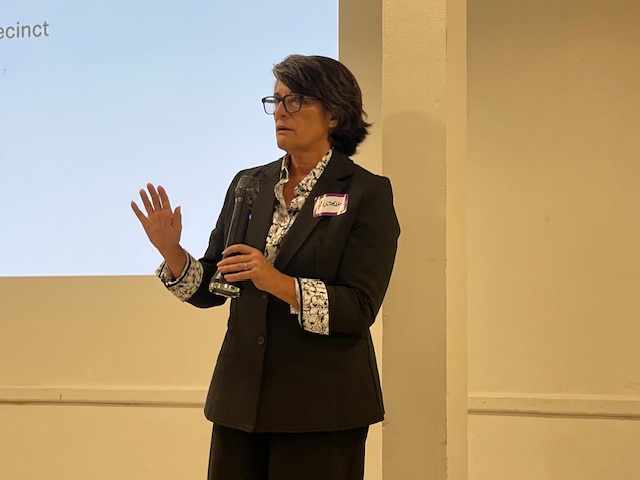
Then Alison Holcomb, Mayor Wilson’s public-safety director, stepped up; Starck talked about the 20-block area of terror and danger on July 4 – she’s collected exhaustive documentation including videos – and said she and others are hoping to figure out to ensure that doesn’t happen next year.
Addressing what Capt. Bair had said about hiring bonuses, Holcomb contended that shouldn’t be a big deal because police salaries were boosted in the newest contract. She also suggested that the bonuses attracted too many unqualified recruits who “washed out.” She said they are concerned about burning out the high-level officers who are training those recruits.
She also made a point of saying that Mayor Wilson is not anti-police. She wants officers who truly care about the city, Holcomb insisted, and she wants to end the “police chief churn” – which Holcomb said was the result of some previous chiefs she considered to be “circuit chiefs” who worked in Seattle to check a box on their resume. (Aside from recently departed Chief Shon Barnes, it wasn’t clear who she might have been referring to; the previous two chiefs had both worked their way up from within SPD, not counting Interim Chief Sue Rahr, who came out of retirement to fill in.)
Holcomb – who described herself as a former longtime criminal-defense attorney and ACLU executive – said what matters most is the relationship police are building with their community. “We’re thinking about the policing that’s actually going to work for you and your community,” She also talked a bit about how crime prevention might factor into that.
Q&A was where things got intermittently contentious. One Alki businessperson said police are slow to respond when called. A co-worker of his asked why Alki can’t get cameras, noting a recent downtown violent crime in which video helped lead to an arrest. “No camera has ever prevented a crime from happening,” Holcomb declared, while going on to say that “the mayor and I are not anti-camera … The mayor has not said no to cameras” but instead has “just launched a pilot … and we won’t do anything else until we evaluate it.” She said the council “broke their proomise” by calling for an expanded program without being sure that they’re not potographing people in the privacy of their own homes. Holcomb said all Wilson has asked for is to pause the expansion. “This question is going to be answered this year,” she promised, adding,”Mayor Wilson does understand the cameras serve a purpose.”
What about the short police staffing? Holcomb reiterated that 47 percent of recruits “washed out.”
Back to the camera issue, Starck asked, wpuld Alki ever get them? If the camera expansion eventually proceeds, what would the criteria be? Holcomb then suggested that the policy analysis should also be seen in the light of other spending priorities for the expected budget crunch – things she thinks should be better at preventing crime, like more police, more lights (which Alki community members have asked for), etc. She said cameras can help bring someone to justice after a crime but can’t prevent it.
Back to the Fourth of July fireworks mayhem- “it felt like a war zone” that night, an attendee said, as concern resurfaced about how to ensure it didn’t happen again next year. Another attendee suggested there should be a public meeting just on that issue. Holcomb said that should be up to Starck, who promptly said she’ll schedule it. But considering fireworks are illegal, some wanted to know, “Why aren’t the rules being enforced?” At that point, Holcomb snapped, “I get it, you just want to send everybody to jail. I want to stop the crime from happening in the first place.”
“We just want to be safe,” somebody in the front row countered, and Starck emphasized that.
Also at the meeting:
ALKI TRICK OR TREAT: It’s scheduled for 11 am to 1 pm on Saturday, October 24. Volunteers needed!
ALKI HOLIDAY LIGHTS: Friday, November 27, is when the Christmas Ship comes to Alki, so that’s the night for the ACC Holiday Lights celebration at the beach. Volunteers are needed for this too!
RESTORING RECREATION TO ALKI CC: As we’ve reported, the Alki Community Center has been a child-care/preschool facility for more than a decade, and the city has said that’s not expected to change any time soon. But the ACC is trying to get some recreation programs restored, and Starck said they’re “making some progress.” As a first step, there are new programs at Alki Bathhouse – Starck provided us with details post-meeting:
The Watercolor and Mindfulness & Meditation are new classes are at the Alki Bathhouse.
Go to the Seattle Parks Home page, and click on “Activities.”. Then scroll down to the “when” “where” section and input or click on the Alki Bathhouse as the location.
https://anc.apm.activecommunities.com/seattle/home?onlineSiteId=0
The watercolor class and meditation classes are listed.
NEXT MEETING: 7 pm October 15, tsunami awareness and political candidates! Watch for updates online between meeting.


No comments